
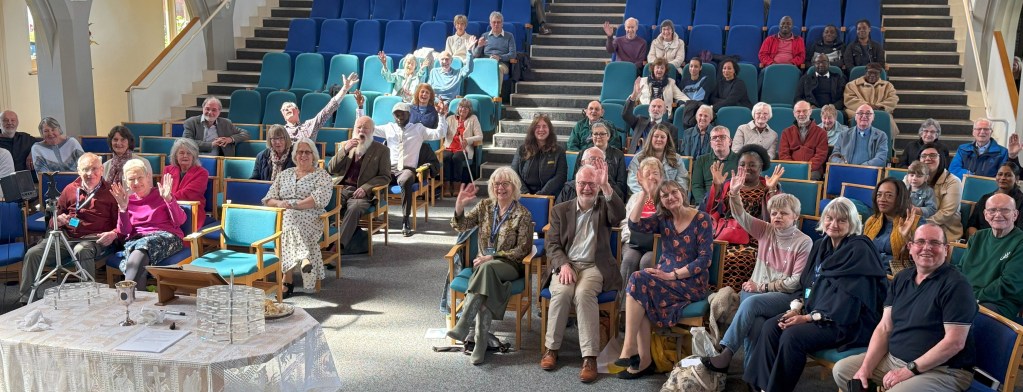
God has led our church through many changes over the years. In hindsight we can see His hand was working all that time. As you read through the events, you will learn how a series of Ministers were inspired to change styles of worship to draw in new worshippers and to serve the community. Attracting young people has been a constant theme. The buildings and contents have been vessels used to spread the Gospel and to bring people to Christ. We are thankful for the guidance of the Holy Spirit in our church which has led us to “Celebrating God’s love, Growing in Christ and Serving our neighbour” over many years.


King Street Congregational Chapel was a thriving church in the centre of Northampton from 1777. In 1901 they decided with the minister, Reverend Larkman, to move away from the town centre to a new location in Abington Avenue which was then on the very outskirts of town. At this time much of the population was moving away from the town centre to the newly developed houses in areas such as Abington, so this was a forward-thinking decision.
A plot of land in Abington Avenue was bought for £1,000 and the schoolrooms were built at a cost of £3,500. For the first ten years these rooms were used both as a chapel and Sunday School. It took another 10 years to raise sufficient money for the new church building, but the building was of our current sanctuary was completed within 12 months of laying the foundation stone. It was an act of faith to take on such a large loan, one as ever honoured by our Lord.
The Uniformed organisations began early in our history; Scouts registered in 1918 and Guides in 1913 with Wolf Cubs and Brownies shortly after. Much later, Beavers and Rainbows were added. For many years they took an active part in the church and monthly parade services continued into the 21st century,
WW1 was devastating to all and many young men from the congregation were lost in the service of their country. During this time the Church rooms were commissioned by the government for use as a military hospital. The Guide company cleaned them every Saturday throughout the War, noting that “towards the end of the war, the cleaning was not always necessary, but it was a great means of keeping the company together as there was nowhere else to meet”


In 1921 a large stained-glass window in memory of those who had lost their lives in the Great War was installed, designed by Sir Frank Brangwen.
Reverend Larkman remained the minister for over thirty years throughout the relocation and building work as well as WW1 and retired in 1926. He was succeeded by Rev Russell, a forward-thinking Minister, who inspiringly preached “we can only attract people to our churches by awakening in them the desire to worship together”.
1930 saw the start of the ministry of Rev. Llewellyn Ellis, who started several initiatives that brought new people, particularly young people, into the church. In 1933 an organ was installed and a service of dedication and celebration held at which professional musicians Mr Thalben-Ball & Mr Howard Fry took part.
3rd September 1939 was a memorable day in British history but especially so for Abington Avenue. During the first service to be led by our newly ordained minister, Rev Owen Butler, on that day he had to announce that war with Germany had been declared. Sadly, as throughout the country, a number of members lost their lives. Once again, the church rooms were requisitioned for war work.

In 1952 Rev Fred Holley started his ministry at Abington Avenue. He suggested several changes to Church services including ‘family worship’ for Sunday mornings and the Young Peoples’ Fellowship taking part in the Evening Services. In 1955 Junior Church was started, with children leaving the main service after 20 minutes for their own departments, a format broadly followed to this day.
In 1961 Reverend Lloyd Jenkins became the new minister. He fostered closer links with Churches in the vicinity, in particular with Adnitt Road Baptist Church and Christchurch C of E. The ministers of the three Churches preached at each other’s’ Churches, held joint discussion and Bible study groups. The young people from these churches went on a 2-week trip to Iona together in 1964 – this must have been considered quite ground-breaking at the time!
In 1970 Reverend David Wilson became the minister at Abington Avenue Congregational Church. In 1972, after due consideration the Church voted to join the new United Reformed Church which joined together the Presbyterian and Congregational Churches in an Act of Union. 1977 saw the start of “Jub Club”, a holiday club for 7-12 year-olds. A later model called Ark Club ran 1986-2005. Messy Church is the current incarnation; this began in 2009
When Rev David Wilson left in 1985, Rev Dennis Hegginbotham became interim moderator. This was the third time he had taken on this role at Abington Avenue since 1962, so although he was never our minister, he was a significant leader in our church and wisely guided us through many changes.
Reverend Peter Flint became our minister in 1987. He and his wife Judith and their young family moved into a new manse within cycling distance of the Church. Our Church rooms had remained more or less unchanged since 1901 and Peter Flint’s ministry saw the start of a major period of redevelopment of our buildings. It took five years of fund raising and building work for the old schoolrooms to be refurbished into rooms ideal for us to expand our outreach mission work in the neighbourhood. Much of this work involved teams of members cleaning bricks, internal structural works, fixing plasterboard, and decorating. The working parties were a time of fellowship and growth as well as being productive. We employed a children’s worker and a cook to enable us to support local families. Family work has always been a central part of our ministry. A modern Nursery enabled us to provide a safe space for vulnerable families and our Child Contact Centre has run there for over 30 years.
In 1995 Rev Mark Westerman became minister. During his ministry our mission to young people and the elderly flourished with many using the church rooms. During Mark’s ministry it was decided that we should embark upon a further development of our buildings and after yet more fundraising we were able to completely modernise the sanctuary and instal our own baptistry.
In 2001 we celebrated the centenary of Abington Avenue URC. One of the events was a breakfast at the Moat House Hotel, the building that was then on the site of the original King Street Chapel followed by walking from there to Abington Avenue for a Centenary service. Both Mark and Peter worked hard to introduce more modern forms of worship in our services, whilst respecting established traditions. A Worship Band was formed to play in some services, an orchestra in others and a new organ was bought as the old one needed extensive repair. Judith’s musical talents were much enjoyed and were helpful making these changes. Mark Westerman retired from the ministry in 2007 and Rev Dr Alan Spence was inducted as our minister in 2008. Alan was an academic, writing several books whilst our Minster and preaching challenging sermons. He worked with Henriette, our youth worker to encourage young adults to grow in their faith. In 2006 a member and organist, Peter Robertson left us a very substantial legacy. The Peter Robertson Fund has enabled us over the years to employ youth workers, carry out various repairs and improvements and to give donations to a variety of good causes both locally and in other countries. A group of 5 members travelled to East Africa to visit different projects that the PRF could sponsor. Various youth groups met at this time GAS (Games and Stuff/ God and Scripture), Godzone and TGI (Thank God it’s) Sundays. Our church logo was adopted at this time, to express our church mission.
In January 2015 we were extremely pleased to induct our new minister Rev Jane Wade. Jane is very active in the URC Synod as Deputy Moderator and has been energetic in collaborating with other local URC churches and minsters. In 2018, she led a group of 13 of the congregation on a pilgrimage to the Holy Land. This was a wonderful experience for those involved, but also brought benefits to the wider church. The Gathering Service was introduced in 2018, which allowed for more informal worship. This runs alongside a more traditional service in the Sanctuary and we still have services all together each month. Jane’s husband, Mark was key to setting up the Gathering. Lockdown was a difficult time for all churches but sadly, Mark died of Covid in 2020 which made it particularly hard for us. We were able to meet together on Facebook, with different couples leading music together. We have continued to stream services most weeks which has been a blessing to many.
2023 saw the start of the Northamptonshire Area Church Partnership; 10 URC churches throughout the county now share 2 ministers – Jane Wade, Liz Adams. We are learning to work together and to seek God’s guidance in this exciting new phase.
“God will make this happen, for He who calls you is faithful” 1 Th 5:24